

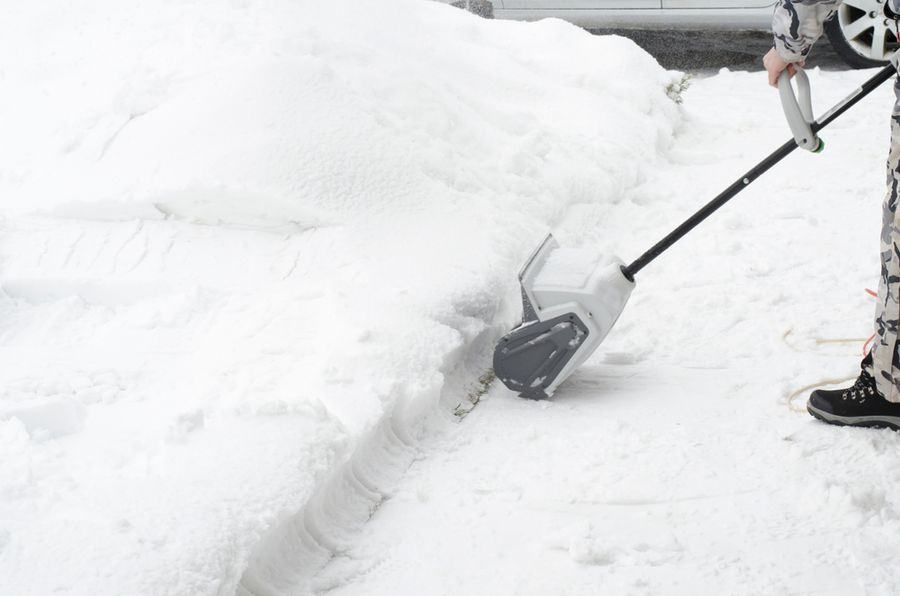
A battery-powered snow shovel can look like the perfect middle ground between a hand shovel and a full-size snow blower. It uses a powered rotor to lift and throw snow, yet its narrow shape requires less storage space than larger equipment. That does not make it right for every home. The best fit depends on the size and surface of the area, the depth of typical snowfall, and how much pushing and steering the user can comfortably handle.
Best for Small, High-Use Areas
Battery snow shovels are designed mainly for focused clearing jobs rather than an entire large property. The Snow Joe 24V-SS12-XR clears a 12-inch-wide path, handles snow up to 6 inches deep, and can throw it up to 20 feet. Its listed uses include decks, sidewalks, steps, patios, and driveways.
That narrow width can be useful around a porch, between parked vehicles, or along a walkway where a wide snow blower feels awkward. It also means more passes will be needed across a broad driveway.
A battery shovel is therefore a stronger match for a townhouse, small suburban lot, or home with only a few important surfaces to clear. Owners of long driveways and large parking areas may get more practical use from a wider snow blower.
Snow Depth Can Limit Performance
A 6-inch clearing depth does not mean the tool is ideal for every 6-inch snowfall. The condition of the snow also matters. The Snow Joe model’s clearing capacity can vary with different snow conditions.
For deeper accumulation, the instructions recommend removing snow in layers of no more than 6 inches per pass. This may require going over the same area more than once after a heavy storm.
Routine clearing can make the work easier. A homeowner may get better results by clearing once during a long storm and again after it ends rather than waiting for the full amount to become packed. Dense piles left at the end of a driveway by a street plow may still be too demanding for this type of narrow machine.
Wheeled Models May Reduce Strain
A standard power shovel must be pushed and guided while the operator manages much of its weight through the handle. Some newer designs add wheels to support the clearing head and make the unit easier to move across a flat surface.
The Ryobi 40V 12-inch wheeled snow shovel clears a 12-inch path through snow up to 6 inches deep and throws it as far as 25 feet. The wheels are intended to improve maneuverability and reduce fatigue while the machine is being pushed.
Wheels do not turn the shovel into a self-propelled machine. The user must still push it, control the direction, and guide it around obstacles. However, the added support may be helpful for someone who finds a traditional shaft-style power shovel tiring to hold at the correct angle.
Consider Where the Snow Will Land
Some battery snow shovels throw snow mostly straight ahead, which can limit how they are used in narrow spaces. A user may need to plan each pass carefully to avoid sending cleared snow onto a walkway that has already been finished.
The EGO Power+ 12-inch snow shovel can throw snow up to 25 feet and provides 60 degrees of directional control. This allows the operator to adjust where the snow is sent rather than relying on a single fixed path.
Directional control may be especially useful beside parked cars, porch railings, property lines, or narrow sidewalks. Even with this feature, users should check that no people, pets, windows, or vehicles are in the discharge area before starting.
Smooth Pavement Is the Easier Surface
Flat concrete, asphalt, and even deck boards give a power shovel a steady surface to travel across. Cracks, lifted pavement, uneven pavers, and loose stones may cause the scraper or rotor housing to catch.
Gravel requires particular care. The Snow Joe manual advises pressing down on the handle so the scraper remains above loose material that could be picked up and thrown. Maintaining that position over a long gravel driveway may be tiring and difficult.
For a small gravel path, careful use may be possible. A large crushed-stone driveway is less suitable because the tool must be kept above the surface while still collecting enough snow to be useful.
Battery Platform and Storage Matter
The Snow Joe 24V-SS12-XR kit includes a 5.0 Ah battery and charger, while the Ryobi wheeled model belongs to Ryobi’s wider 40V outdoor tool system. A compatible battery platform may add value when the homeowner already owns lawn tools from the same product line.
Shoppers should check whether a listing includes the battery and charger or sells only the tool. They should also confirm the exact voltage and product family because batteries from one brand are not automatically compatible with every tool carrying that name.
Storage is simpler than with many full-size snow blowers, but the machine still needs a protected location. The battery should be removed after use, and the shovel should be checked for loose or damaged parts before it is put away.
Powered Equipment Still Requires Caution
A battery snow shovel may be compact, but its rotor can cause serious injury. Stones, toys, cords, branches, and other loose objects should be removed from the clearing area before the machine is switched on.
Hands and feet must remain away from the rotor and discharge opening. Injuries involving snow equipment frequently occur when users try to clear a blocked auger or discharge area by hand.
The machine should be turned off, the battery removed, and all movement allowed to stop before a blockage is inspected. Any clog should be cleared according to the manufacturer’s instructions rather than by reaching into the housing.
A Practical Choice for the Right Property
A battery-powered snow shovel can be ideal for a home with a deck, porch, sidewalk, steps, or short paved driveway. It offers more mechanical help than a hand shovel without requiring the space or upkeep of a full-size snow blower.
It is less suitable for deep drifts, heavy plow piles, wide driveways, and large gravel areas. A wheeled design may be easier to guide, while directional discharge can make clearing tight spaces more controlled. The best choice is based not only on snowfall totals, but also on the exact surfaces and distances that need to be cleared.